
When we sat down and looked at our values, what we wanted out of our lives, and where we were misaligned, the thing that really screamed out at us was a need to slow down. We were constantly trying to do too many things, jumping headfirst into new projects with an optimism and mantra that “we would make it work”. But it was apparent that we weren’t making it work. Our attention was constantly divided between too many projects, never having focus on one thing for long enough to see it through to completion.
We would steamroller from one project to the next, never stopping to reflect or ponder whether this was really what we wanted to be doing with our time. There was just too much on the to-do list, and not enough time to complete it all. We were also doing a lot of things out of a feeling of necessity or obligation, rather than because it fitted with our values.
Putting Children First
It felt like our backs were against the wall, but it was difficult to clearly see what could be changed. However, we had made a commitment to home educate the kids, which meant choosing 24/7 childcare for both of them on top of mounting to-do lists. You could argue that taking that on, on top of an already stressful home life, would tip us over the edge. However, it proved to be the opposite.
By choosing to put the children first in this decision, we were consciously acknowledging—for the first time, perhaps shamefully—that the children’s needs are the most important thing. Not what others think of us, not what we want or have achieved in our lives, not what house we are living in or how much money we have to our name. Just that our children are content and healthy.
By choosing to put the children first in this decision, we were consciously acknowledging that the children’s needs are the most important thing.
We had convinced ourselves that the children needed more than safety, love, nourishment, food and shelter from us as parents. We were swept up by the belief that this was not enough, that the children also needed the large house and dedicated play room, the trampoline in the oversized garden, more toys than they knew what to do with, the after-school clubs and the expensive holidays. But by striving too hard to provide these at the expense of the quality time and real presence we could have been giving to the children, we did not show up for them in the way we really wanted.
We slowly gained clarity, through a long process of reflection, on what was actually working for us as a family and what wasn’t. We knew that we had to make some serious changes to fulfil our commitment to home educate, and in a backwards sort of way, this was what sent us on a long journey to realign with what we value. We knew we couldn’t carry on as we were, and so we set about the process of trying to slow down.
The Rush of School Life
Life in school had felt restrictive. As parents we were constantly time-checking, rushing from one activity to the next, cajoling the kids and never making the time to stop and just be. Our collective blood pressures would rise each weekday morning as we fought against the clock to wash, dress, prepare packed lunches and wolf down breakfast in an attempt to get to the gates on time. I would then run through the day whilst they were at school, always on a time constraint, knowing the few hours would disappear in a heartbeat and I would soon be back at the gates in time for pick-up.
When they were home, the kids were too tired and overwhelmed to spend time focusing on anything else. They visibly took time to unwind from the overstimulation of the day, leaving little time for us to spend quality time together before it was dinner, bath and bedtime.
Our weekend rhythms looked and felt very different from that of the weekdays, and the holidays were very different to the term times. It was this constant pattern of rushing through term time at high speed in order to make it to half term and collapse that didn’t feel healthy. It didn’t feel like it was delivering the right message to the kids either. They would get so tired, so overwhelmed, so run down, that we would spend most of the weekends or half term recovering from coughs and colds rather than enjoying quality time together.
Stepping Off the Train
When we metaphorically jumped off the train and de-registered from school, what we created was an immediate slowing-down. We had the chance to move towards the slower pace of life that we had been craving. We were fortunate that Jimmy and I were self-employed and so had the luxury of dictating our own hours. It meant that we had the opportunity for a full reset, a turning back of the clocks to zero in effect.
Instead of having our days, weeks and years dictated to us by the school timetables, we were able to set our own agenda—a schedule based around the rhythms that worked for the four of us.
Instead of having our days, weeks and years dictated to us by the school timetables, we were able to set our own agenda—a schedule based around the rhythms that worked for the four of us. We suddenly felt like we had more time in the day. Instead of waking and rushing through the morning to get to the gates on time, we could start a new morning routine, one that involved starting the day with mindful activities such as yoga or exercise, stories or art. Then a nutritious breakfast prepared and eaten together, creating new recipes and expanding the kids’ skills in the kitchen as a new way of learning.
The weekday mornings instantly took on the same relaxed vibe as the weekend. We were creating and modelling how we wanted life to feel, no matter the day of the week.
Simplifying Daily Life
The washing burden seemed to shrink overnight. Instead of completing two sets of laundry, one for the school uniform and one for the after-school clothes, it became one big pile. Spending more time at home and out in nature meant I allowed myself to lower the standards I had held for maintaining the school uniform and thus could focus more of my energy on the kids. This also looked like them getting involved in household chores, learning essential life skills from an early age and sharing the burden so that more time could be spent on playing.
The kids enjoyed pairing up the clean socks or racing to put their clothes away before the other, and it became a game as well as a lesson.
Likewise, the burden of meal preparation and clean-up also felt smaller. Instead of effectively making and washing up from lunch twice, by having to prepare packed lunches for the kids in the morning then our own lunch later on in the day, we instantly took this down to one shared meal together. We had the ability to prepare and eat three meals a day together as a family for the first time since my daughter started pre-school, something I have always valued greatly. The kids were able to get involved in the meal design and food preparation as well as the clean-up, taking it in turns to wash or dry the dishes.
Reconnecting with Nature’s Rhythms
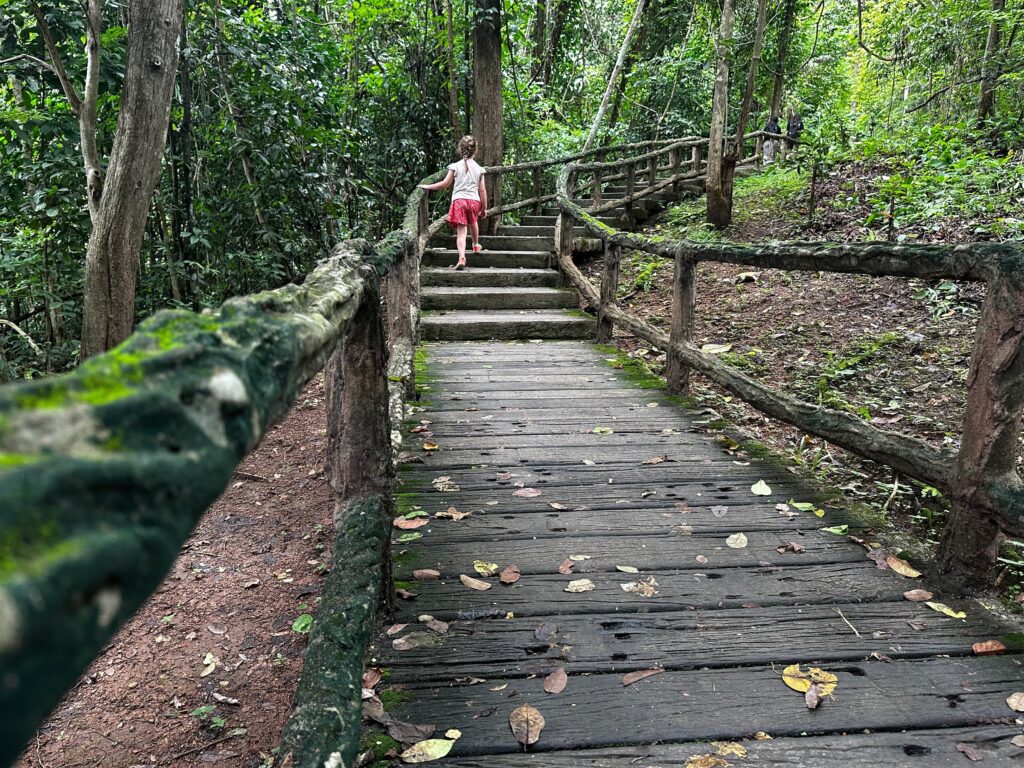
Since slowing down, we have been able to better acknowledge nature’s rhythms. Being able to prioritise getting outside in the early morning air and light, by playing in the garden or going for an early walk, has been really important for us to ensure good sleep at night. This became possible by removing our commute to school, as our rural setting by a main road made it unsafe to walk or cycle to the gates. Walking through the fields around our house meant we had the chance to catch up on the news of our neighbours, feeling more connected in our community and ensuring the kids felt included in that.
We are all connected, to each other and the nature surrounding us, and it feels increasingly important in today’s fast-paced society to show the kids how we can try to live in harmony with it.
In the winter months we could prioritise our time so that we were outside during daylight hours, then focusing on work or quieter indoor pursuits inside when it was dark. This was a big win for us, particularly during those long, dark January days in the UK, helping dramatically with our wellbeing.
The benefits of living in harmony with nature have been known by ancient Eastern healers for centuries and are increasingly being proven by scientists in the Western world. Walking barefoot on the grass, hugging a tree or being outside as soon as we wake have profound effects on the bodily system that calms us, lowers our heart rate and blood pressure and ensures good digestion of our food (the parasympathetic system). We are all connected, to each other and the nature surrounding us, and it feels increasingly important in today’s fast-paced society to show the kids how we can try to live in harmony with it.
To acknowledge the seasons, the daylight hours dictating our circadian cycles and honouring our body’s own individual rhythms or constitutions. Slowing down and moving to an outdoor lifestyle as much as possible has allowed us to incorporate as many of nature’s lessons as we can, and has had positive impacts on my health.
Honouring Individual Needs
Choosing a life without school means that the kids can go to the toilet when they need to, rather than having to wait until the lesson has finished, and they can choose to eat only when they are hungry. It is no longer a problem that our daughter takes a while to wake up in the morning and to be ready for her first meal of the day. She can eat when her stomach is ready and not feel pressurised to eat because we are worried she will go hungry at school if she does not.
Likewise, if we eat a later breakfast because we choose to do an early family bike ride first thing, then my son can have a piece of fruit if he needs to fuel his eager appetite before having a hearty breakfast later in the morning. We can more easily live in our own flow and accept each other’s individual needs.
On this journey of slowing down and living a simpler existence, we have been able to better prioritise rest and wellbeing. It has been easier to ensure that the kids do not become overtired or run down like they did in the long term times at school, and so we better avoid the coughs and colds which seem to run rampant in the colder months. This may mean lying in bed longer when they need to or having a nap in the afternoon.
We have the flexibility to ensure that we prioritise and do not over-commit, so that we all remain focused and well. In reality it is not often necessary. The kids do not get to the same levels of overstimulation that they did in school, so it is easier to curate the day so that we are all in wind-down mode from earlier in the evening and thus very much ready for our beds. This often looks like quiet activities later on in the day or some time out in nature, well away from any screens, to ensure we acknowledge when our bodies are telling us we are tired.
Slow Is Not Lazy
A slower pace of life is not a lazy life. It is not about avoiding commitments and falling short on goals. It is about being clear on what your goals are and ensuring that you are expending energy in the right places. With the children, this way of life has allowed them to deep dive into things that truly capture their interest. By slowing down and allowing them to get bored, not pre-prescribing what they are doing in every minute of the day, they have had the opportunity to develop what they are truly interested in.
They have been able to dabble in things, giving them a go because they are curious or had an idea, without the pressure of achievement or getting it wrong.
They have been able to dabble in things, giving them a go because they are curious or had an idea, without the pressure of achievement or getting it wrong. As well as developing their curiosity, creativity and resourcefulness, it strengthens the muscle of self-regulation and adaptability. They are able to self-regulate when they are feeling bored or inspired, and if we step back and allow them to feel it, they will often find another topic of interest or persevere with what they were trying.
They have also proven time and again that when given the space and time, they can deep focus on an activity for hours on end, returning to it across several days. They show natural abilities to self-motivate and a desire to self-improve. We just have to have the trust in them and strength of conviction as parents to just let them be.
Finding Purpose Through Stillness
By slowing down, we have all strengthened our inner desires to create, to connect, to do good in this world. By being in nature and trying to re-connect with natural rhythms, we have regenerated a deep sense of purpose. Jimmy and I are more able to make clear decisions and work out the forces and purposes driving us each day. Being clear on that enables us to make decisions about where to place our energy.
We all produce our best work by slowing down, remaining present in the moment, not by surrounding ourselves with “busy activities” that obscure the bigger picture. Isaac Newton is quoted as saying “Truth is the offspring of silence and meditation”. I am sure he did not come up with his great laws of motion by being busy all the time, but more through mindfully engaging in meaningful work to fuel his purpose and create inspiring theories.
Mahatma Gandhi, another great human who contributed to the betterment of human existence, is quoted as saying “I have so much to accomplish today that I must meditate for two hours instead of one”. In essence, to achieve more, you must provide yourself with the grounding and self-care needed to nourish yourself so that you can then go out in the world and achieve your deeper purpose.
That is what we are trying to create with a slower pace of living. Being more mindful and present, making time for fun and joy and quality family moments, fuelling our minds with movement, fresh air and good nourishment, so that when we come to sit and focus we can create our best work. It allows us to be the best version of ourselves, using our natural abilities to do good and create something meaningful. That is what we are trying to model with the kids also.
The lure of the exciting world outside is strong and provides with it much fun, but also many distractions. As parents, by trying to slow down and re-connect with nature, we are trying to educate the kids about the importance of fuelling our bodies and minds so that we can stay connected to our true purpose. Human beings are not naturally idle creatures, but laziness can creep in when we are confused about what our purpose is and what we want to achieve. We become so frozen by all of the possibilities of what we could do that we do none of them. This comes from a lack of clarity, not always a lack of capacity.
Meditation has become the grounding tool for me in trying to stay connected to a greater purpose. Through observing the kids at play, it is clear that they already have a deep sense of knowing in this respect. They just need the love, the support, the gentle guidance and the resources to go into the world and create what they were put here to do, rather than get conditioned into limiting their capabilities to meet the expectations of others.
Living More Intentionally
The essence of a “slow pace of life” is to live more intentionally. For us it has just felt calmer. Losing the pressures to conform and perform, for both the children and us as their parents, has slowed us down and made us appreciate each other that little bit more. We have been able to adopt a work-life integration approach, rather than striving for work-life balance, which kept failing. We have had the chance to reimagine what life could look like, feel like, and it has been the best thing about stepping away from school.
We would never have been able to get the quality time we have had together as a family if we had stayed in the school system, and for this I would do it all over again.
We would never have been able to get the quality time we have had together as a family if we had stayed in the school system, and for this I would do it all over again. We are all too aware that these precious years are disappearing quickly, and that it may just be a short season of our lives. So whilst the kids are young and enjoy spending their time with us, we want to do what is in our capacity to celebrate that and cherish them whilst they are here. There are many arguments to home educate or not, but for me this has proven fundamental in everything we hold dear as a family and one of the biggest driving factors to try to continue to make it work for us all.
Frequently Asked Questions
We recognised our need to slow down when we felt constantly overwhelmed, jumping from project to project without focus, and doing things out of obligation rather than alignment with our values. If you’re always rushing, feeling like your attention is divided, or struggling to find quality time together as a family, these might be signs that slowing down could benefit your family too.
We started by de-registering from school, which gave us immediate permission to slow down and reset our family rhythms. The key was recognising that we had the opportunity to set our own agenda based on what worked for our family of four, rather than being dictated by school timetables. Having the flexibility of self-employment certainly helped us make this transition.
We found that removing school actually reduced our overwhelm rather than increasing it. The key was simplifying daily tasks like washing and meal preparation, getting the kids involved in household chores as learning opportunities, and creating new morning routines focused on mindful activities rather than rushing to meet deadlines.
We’ve discovered it’s absolutely possible and has dramatically improved our wellbeing. We prioritise getting outside in early morning light, spend winter daylight hours outdoors and focus on indoor activities when it’s dark, and allow our children to eat when hungry and rest when tired. These small changes have had profound effects on our family’s health and happiness.
We’ve learned that a slower pace of life isn’t about being lazy—it’s about being intentional with our energy. Our children have shown remarkable abilities to self-motivate, deep focus on interests for hours, and develop creativity and resourcefulness when given the space and time. They just need our trust and the freedom to explore what genuinely interests them.
We shifted from trying to achieve work-life balance to embracing work-life integration. Being self-employed gave us flexibility, but the key was getting clear on our purpose and where to direct our energy. We found that by slowing down and being more present, we actually produce our best work while still prioritising quality family moments.
We’ve experienced deeper family connections, better health through reduced stress and more time in nature, and a clearer sense of purpose. Our children are developing self-regulation skills, creativity, and the ability to pursue their genuine interests. Most importantly, we’re creating precious memories together during these fleeting years when our children still want to spend time with us.